Senior Product Designer working from strategy to shipped code. I build scalable design systems, prototype with AI, and design for conversion.
BASED IN BEAUTIFUL COLORADO, USA
BY THE NUMBERS
8+
YEARS PRODUCT DESIGN EXPERIENCE
25+
YEARS CREATIVE EXPERIENCE
10+
INDUSTRIES SERVED
Key Expertise
( SCROLL )
/01
Design Systems at Scale
I build and evolve scalable design systems and component libraries, including a custom component registry teams install and build from, that improve consistency, accelerate development, and let teams ship on-brand faster. I vibe-code prototypes directly on top of my own systems, which frees up more time for user testing instead of production polish, and hands off to engineers who are already building in that same system.
/02
AI-Assisted Design & Front-End
I design from concept through to working code, using AI-assisted workflows, Claude Code, Cursor, Figma MCP, and v0, to prototype fast and hand off production-ready UI. I also design AI-powered product features, keeping people at the center.
/03
Conversion-Driven UX & Experimentation
I drive measurable outcomes through data-informed UX, A/B testing, and personalization, improving conversion, AOV, and operational efficiency across eCommerce and SaaS.
/04
Design Leadership
I lead UX strategy from research through iteration, mentor designers, set design vision, and establish the systems, rituals, and standards that let design scale across product, engineering, and go-to-market teams.
MOBILE & WEB APP DESIGN
I create intuitive and visually appealing interfaces that enhance user experience across multiple platforms. Versed in key UI design systems.
Design that ships & converts.
FEATURED WORK
Portfolio.
Projects that speak volumes.
SELECTED CASES /04
{{ p.cat }}COMING SOON
/{{ p.num }}
{{ p.title }}
{{ p.desc }}
WANT TO SEE MORE CASE STUDIES?
Let's Connect
ECOMMERCE SOFTWARE/03
Livewire.
eCommerce Site Management Software
ROLE & SCOPE
Lead Product Designer owning UX strategy, design systems, and cross-functional alignment. Platform supporting merchandising, content, and inventory workflows for Cotopaxi's eCommerce ecosystem.
PROBLEM
Existing tooling fragmented merchandising workflows and slowed decision-making across teams.
OUTCOME
Designed a scalable dashboard system that improved operational clarity, reduced friction, and supported faster merchandising decisions.
TECH STACK
{{ x }}
The Process
PHASE /{{ st.num }}
{{ st.t }}
{{ st.d }}
PRODUCT FLOW CHART
This flow chart outlines the various offerings users rely on to maintain their areas of focus within the company. It illustrates how these separate tools and processes are streamlined through Livewire, funneling them into a unified dashboard. This dashboard enables eCommerce managers and merchants to manage all data and information directly from the source and seamlessly integrate it onto the site, simplifying operations and enhancing efficiency.
FLOW CHART, SUPPLY IMAGE
USER FLOWS, SUPPLY IMAGE
USER FLOWS
User flows mapped out the journey of site merchants and eCommerce managers, highlighting their interactions with the new dashboard. They helped identify potential pain points, streamline processes, and ensure the design aligned with their needs, and communicated the design vision to stakeholders.
USER INTERVIEWS
I conducted interviews with site merchants and eCommerce managers to understand their needs and pain points. Additionally, I interviewed engineering teams to identify the limitations of the available APIs and app integrations, ensuring the design would be both functional and technically feasible.
INTERVIEW NOTES, SUPPLY IMAGE
LOW FIDELITY PROTOTYPES
LOW-FI WIREFRAMES, SUPPLY IMAGE
BRAND IDENTITY
TYPOGRAPHY
DEFAULT COLORS
GRAYSCALE
LIGHT MODE
The Prototype
HI-FI PROTOTYPE, EMBED OR SUPPLY IMAGES
CONTENT + COMMERCE/05
Common Thread.
Blog Management Software, Content + Commerce Platform UX, Dashboard Strategy
ROLE & SCOPE
Lead Product Designer responsible for UX strategy, research, and system design for a blog and content management platform supporting merchandising and editorial workflows.
PROBLEM
Content publishing workflows were fragmented, error-prone, and disconnected from merchandising needs, slowing time-to-publish and increasing operational overhead.
OUTCOME
Designed a unified content management experience that streamlined publishing, improved visibility into content status, and reduced friction between editorial and commerce teams.
TECH STACK
{{ x }}
The Process
PHASE /{{ st.num }}
{{ st.t }}
{{ st.d }}
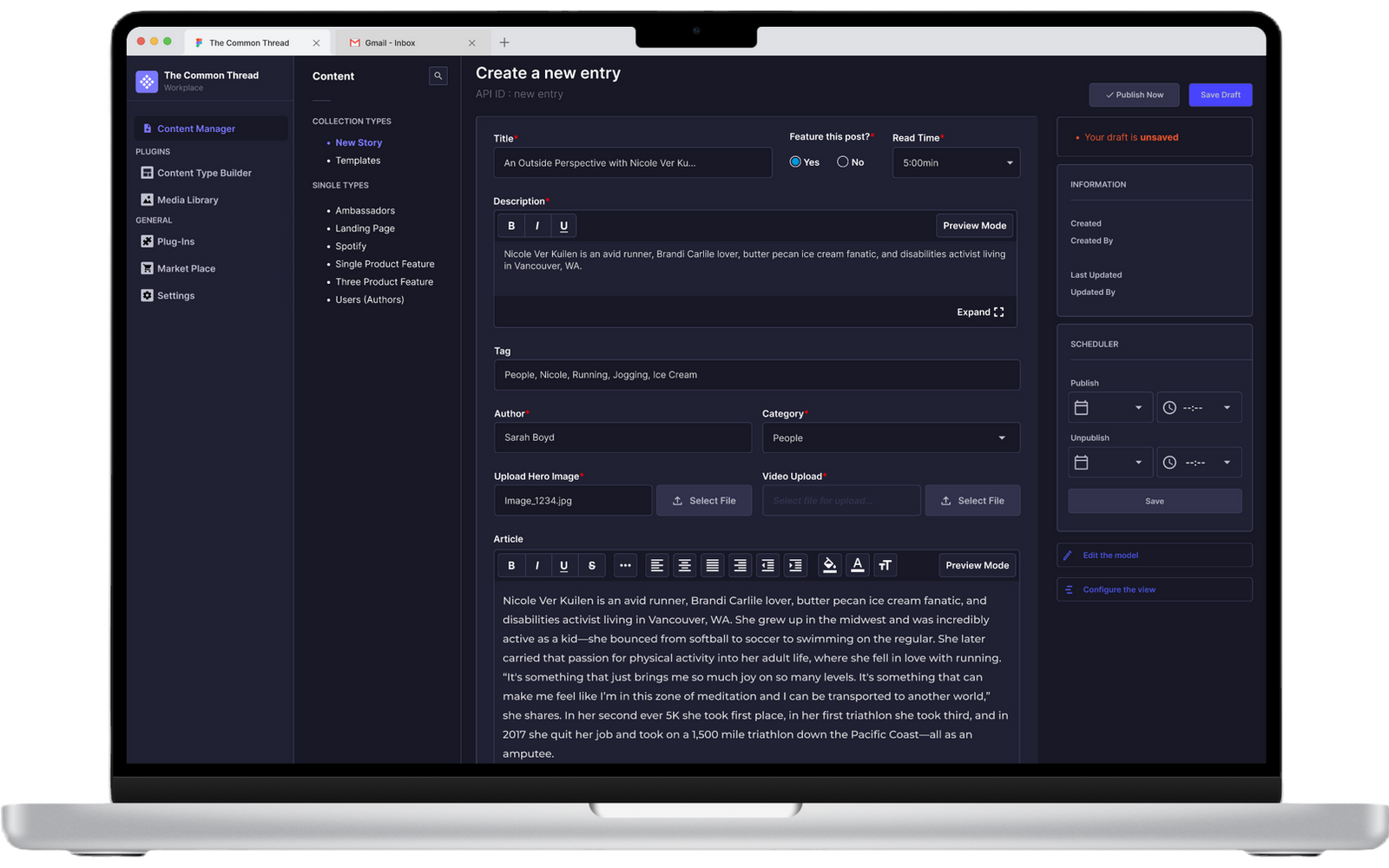
WIREFRAMES, BACKEND
The backend wireframes outline a clear layout: a dedicated area for writing and editing blog posts, a user and author management section where admins can update roles and permissions, and a media management area for organizing and uploading images and videos, effortlessly inserted into blog posts.
BACKEND WIREFRAMES, SUPPLY IMAGE
FRONTEND WIREFRAMES, SUPPLY IMAGE
WIREFRAMES, FRONTEND
The frontend wireframes show how the backend content will translate onto the site. These low fidelity wireframes provide a clear visual guide for stakeholders, ensuring all essential features are logically arranged and easily accessible.
USER INTERVIEWS
Interviews with content creators, editors, and merchandisers uncovered where publishing broke down, and where merchandising opportunities inside blog articles were being missed. Engineering interviews confirmed what the API-based approach could support.
INTERVIEW NOTES, SUPPLY IMAGE
The Prototypes
LOGIN, SUPPLY IMAGE
DASHBOARD, SUPPLY IMAGE
AI MOBILE APP / ILLUSTRATION SYSTEM/03
Spindletale.
Generative AI children's stories, illustration system, and supporting design system. Product Designer · UXR · Project Manager
OVERVIEW
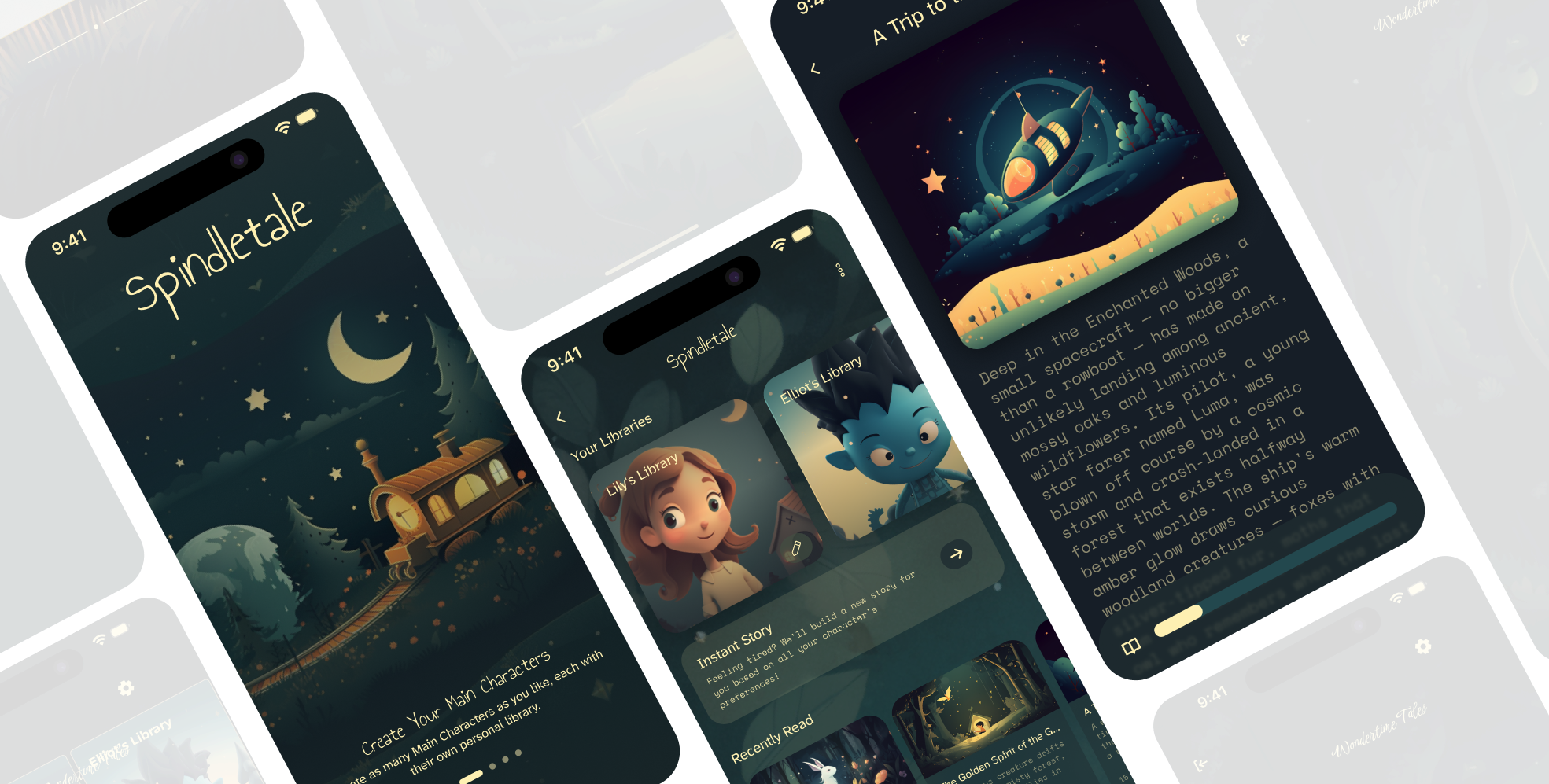
Spindletale is a tablet-first mobile app that uses generative AI to craft one-of-a-kind children's stories from a few simple prompts, characters, themes, length, and tone. The hard part wasn't the model; it was designing trust, delight, and visual consistency around it. The centerpiece of this case study is the illustration system I built, a planning pipeline that keeps every page on-style, on-character, and advancing the story.
TECH STACK
{{ x }}
The Process
From market signal to a shippable story experience, research first, then flows, then the systems that make the product feel coherent.
PHASE /{{ st.num }}
{{ st.t }}
{{ st.d }}
Competitor Research
I audited similar AI story apps through reviews and walkthroughs, looking for where personalization delighted kids and where paywalls, prompts, and safety broke trust. The patterns below became the brief for Spindletale.
{{ c.name }}
/{{ c.num }}
PROS
+{{ x }}
CONS
−{{ x }}
WHAT THAT RESEARCH POINTED TO
Key takeaways
/{{ k.num }}
{{ k.t }}
THE CORE OF THIS CASE STUDY
The Illustration System
This is the most important piece of what I built for Spindletale. AI-generated children's book art usually fails in one of two ways: it looks generic (same style every time), or it falls apart page to page (characters who don't match themselves, images that don't advance the story). I designed a system that treats illustration as a planning problem, not a per-image prompt problem.
The architecture is a three-stage pipeline: the story is planned first, visual decisions are made second, and only then is a generation prompt compiled. Swapping in a real image model (GPT-image-1) required zero changes to the planning logic, the renderer is a pluggable interface; composition and prompt layers carry the design intent.
THREE-STAGE PIPELINE
{{ st.num }}
{{ st.t }}
{{ st.d }}
STYLE GUIDE
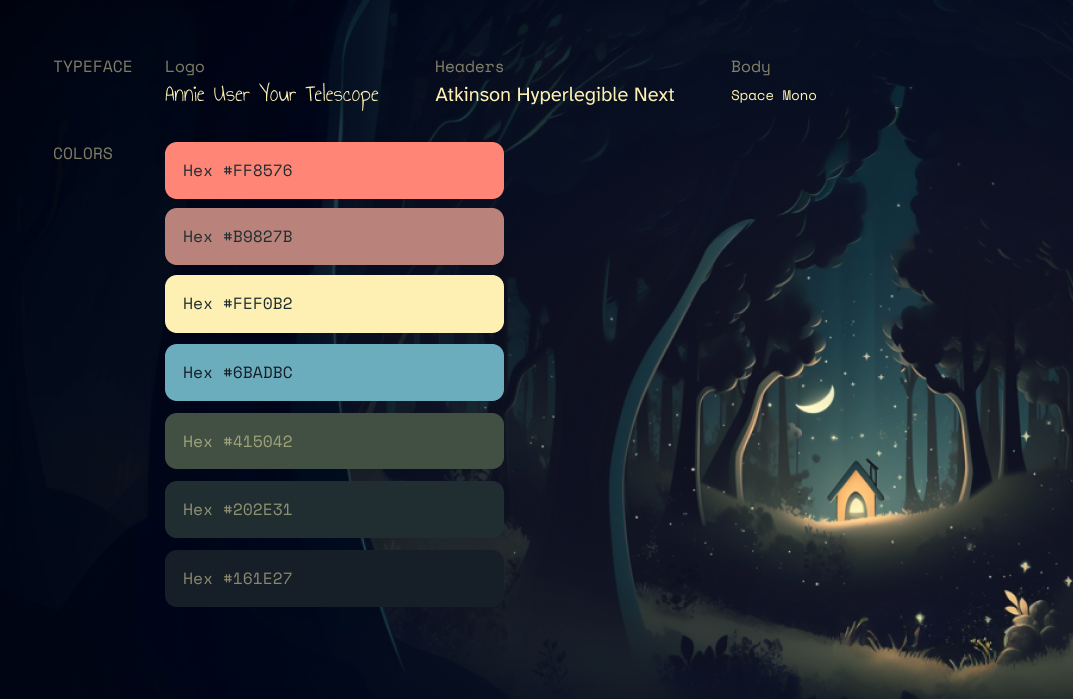
I invented the visual language from scratch and encoded it as explicit composition rules, not prompt-writing intuition:
→{{ r }}
CHARACTER CONSISTENCY
The hardest problem: early versions illustrated characters that didn't match the avatar the user picked. Fixed by threading the character's actual description, species, and coloring through the whole pipeline (heroAppearance, later extended to supporting characters) so every image prompt carries the specific character, not a generic placeholder.
The system also avoids inventing extra recurring characters across stories, each story is meant to feel new.
ORIGINAL ILLUSTRATIONS
Built from nothing to define and prove the system, not adapted or remixed from client reference art.
APP PREVIEW
The Prototype
High-fidelity screens for the core story loop, from onboarding and home through character setup, library, reading, and listening.
DESIGN SYSTEM
The Design System
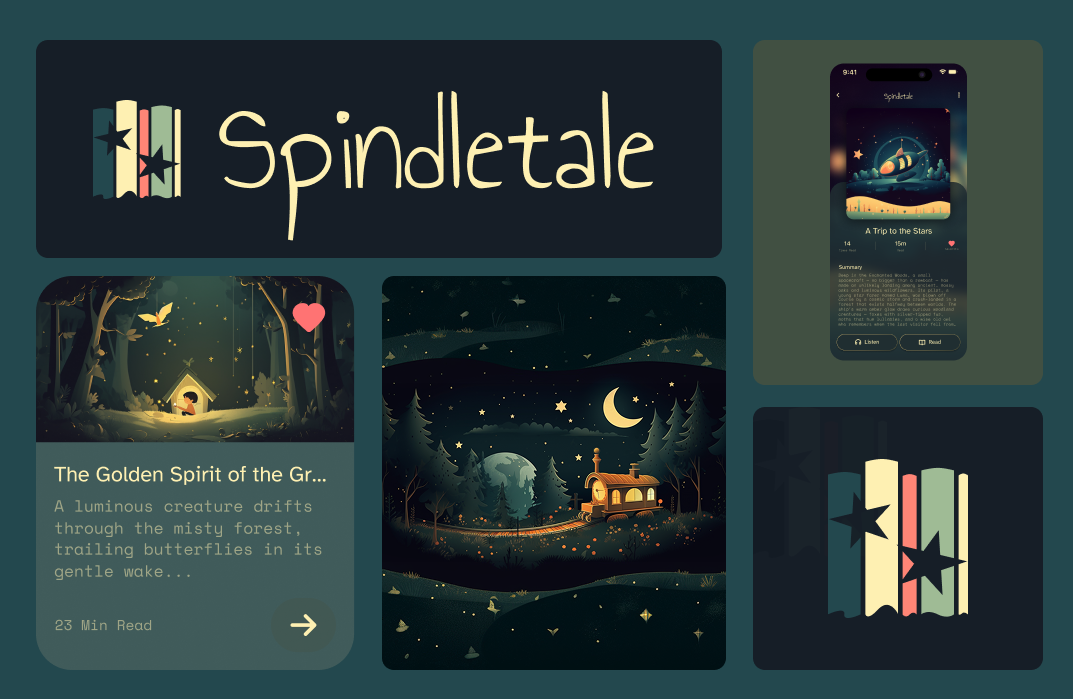
Alongside the illustration language, I built a product design system so the app UI, prompts, reader chrome, and library, stays as consistent as the art. Tokens, components, and patterns tuned for tablet-first storytelling.
{{ st.t }}
{{ st.d }}
DESIGN SYSTEMS & DEV TOOLING/01
Project North Star.
A component registry design system, installed via CLI and vibe-coded on top of, not just documented.
Work done under NDA, anonymized here as Project North Star. Stack: React 19, Tailwind CSS v4, shadcn/ui + Radix primitives, TypeScript, a custom CLI-distributable component registry, Figma.
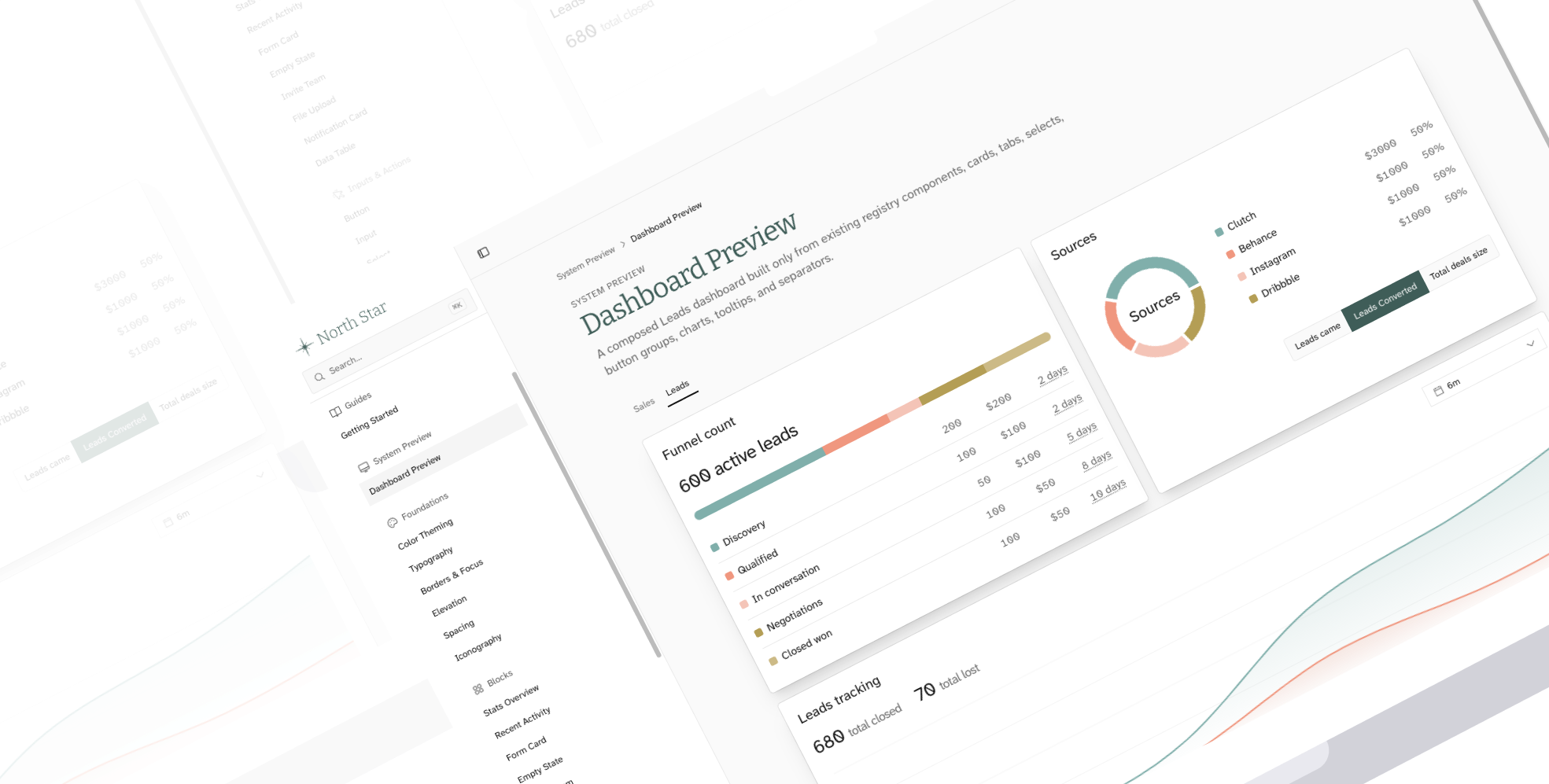
PLATFORM PREVIEW, DASHBOARD COMPOSED ENTIRELY FROM REGISTRY COMPONENTS
ROLE & SCOPE
Design system lead, owning the UX strategy, token architecture across code and Figma, component design, build and rollout. The registry itself is code I authored, not just a spec or Figma file handed to engineers.
PROBLEM
No shared component system existed outside a Figma library, so teams rebuilt the same components slightly differently, and increasingly vibe-coded prototypes with AI tools that produced generic, off-brand UI needing cleanup.
OUTCOME
A CLI-installable registry, used to build its own docs site, that both humans and AI tools assemble genuinely on-brand UI from, with no designer babysitting every screen.
TECH STACK
{{ x }}
The Build
PHASE /{{ st.num }}
{{ st.t }}
{{ st.d }}
WHY A REGISTRY, NOT A STORYBOOK
A Storybook is a documentation layer, it renders components in isolation so people can look at them, but they still live elsewhere. North Star is a distribution layer: a repo with a component registry, the shadcn model, where each component is a self-contained file a team pulls into their own codebase with one CLI command. They get the actual source, styled with our tokens, which they own and can adapt. The registry is the product; documentation is a byproduct.
THE SYSTEM BUILDS ITSELF
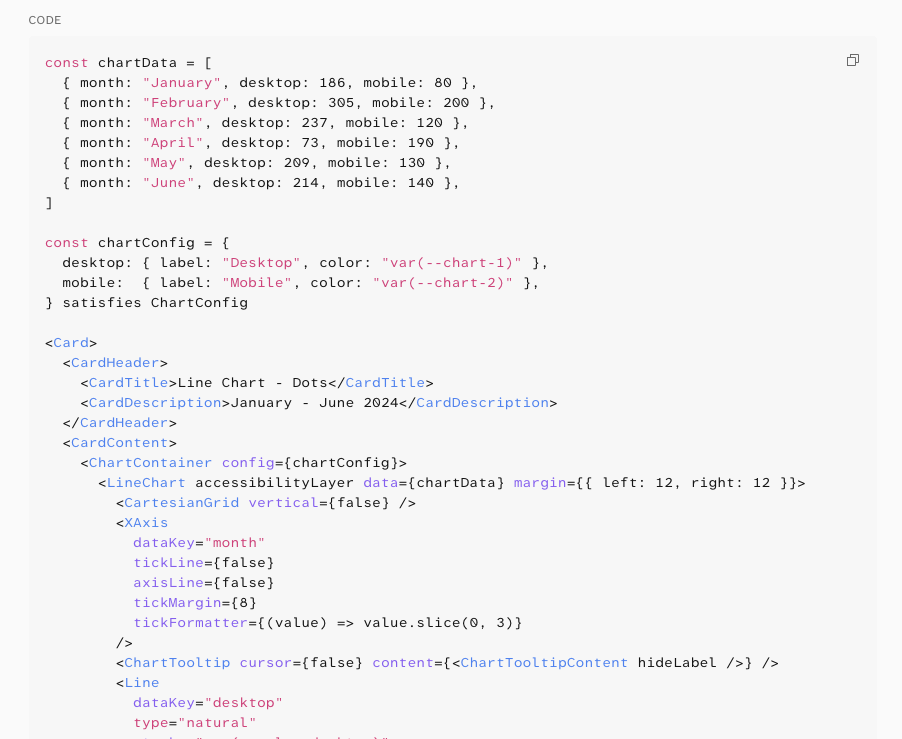
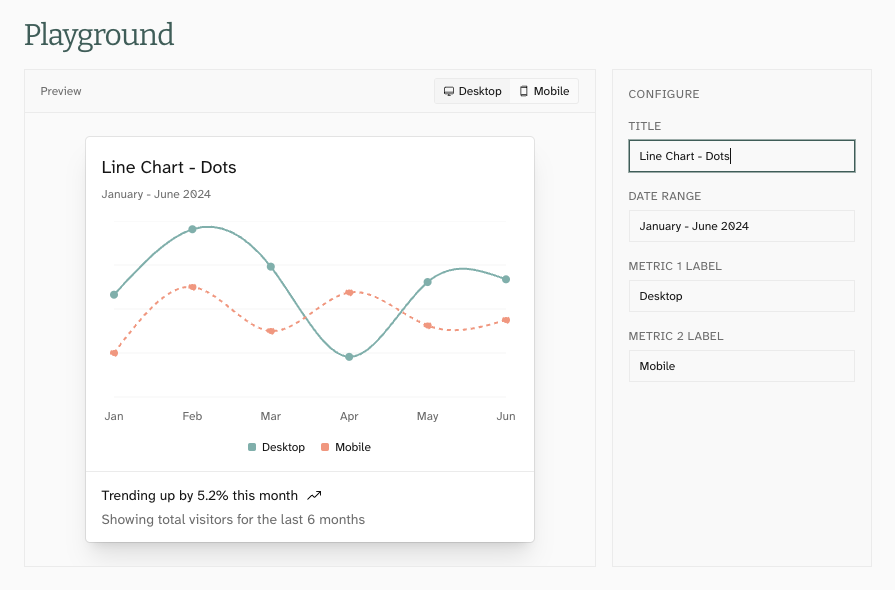
Every page of the documentation, navigation, buttons, code blocks, interactive playgrounds, the theme toggle, is composed from the exact same registry components teams install. There is no separate docs stack styled independently. That makes drift structurally impossible: if a token changes, the docs re-theme with it; if a component's API changes, the docs break in CI until they're updated. The system's own UI is a permanent, live integration test.
ONE SYSTEM, EVERY SURFACE
The registry isn't only a codebase. I used Figma MCP to bring the coded components back into Figma and to build a matching Figma token library, so design files and the codebase reference the same source of truth instead of drifting apart. From there I extended the system to meet people wherever they already work.
FIGMA
Coded components synced into Figma via MCP, plus an MCP-built token library, so designers work from the same components and tokens engineering ships.
CLAUDE DESIGN
A Claude Design Design System built directly off the registry, so anyone vibe-coding in Claude Design starts from North Star's real components and tokens.
CURSOR & CODE-FORWARD TOOLS
A "Get Started" page and companion skills package an app shell for Cursor and similar tools, so engineers can scaffold a new experience straight on the registry.
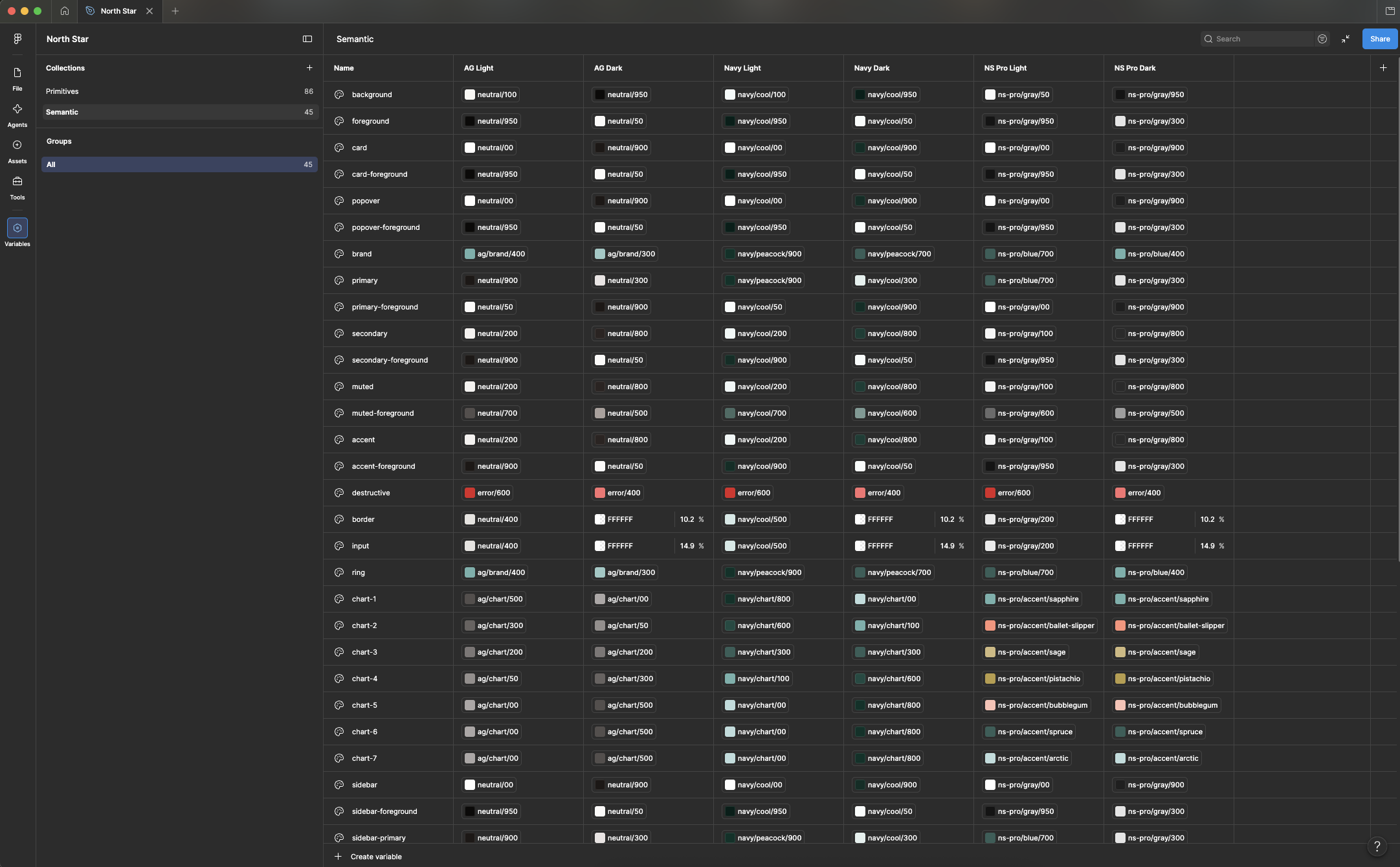
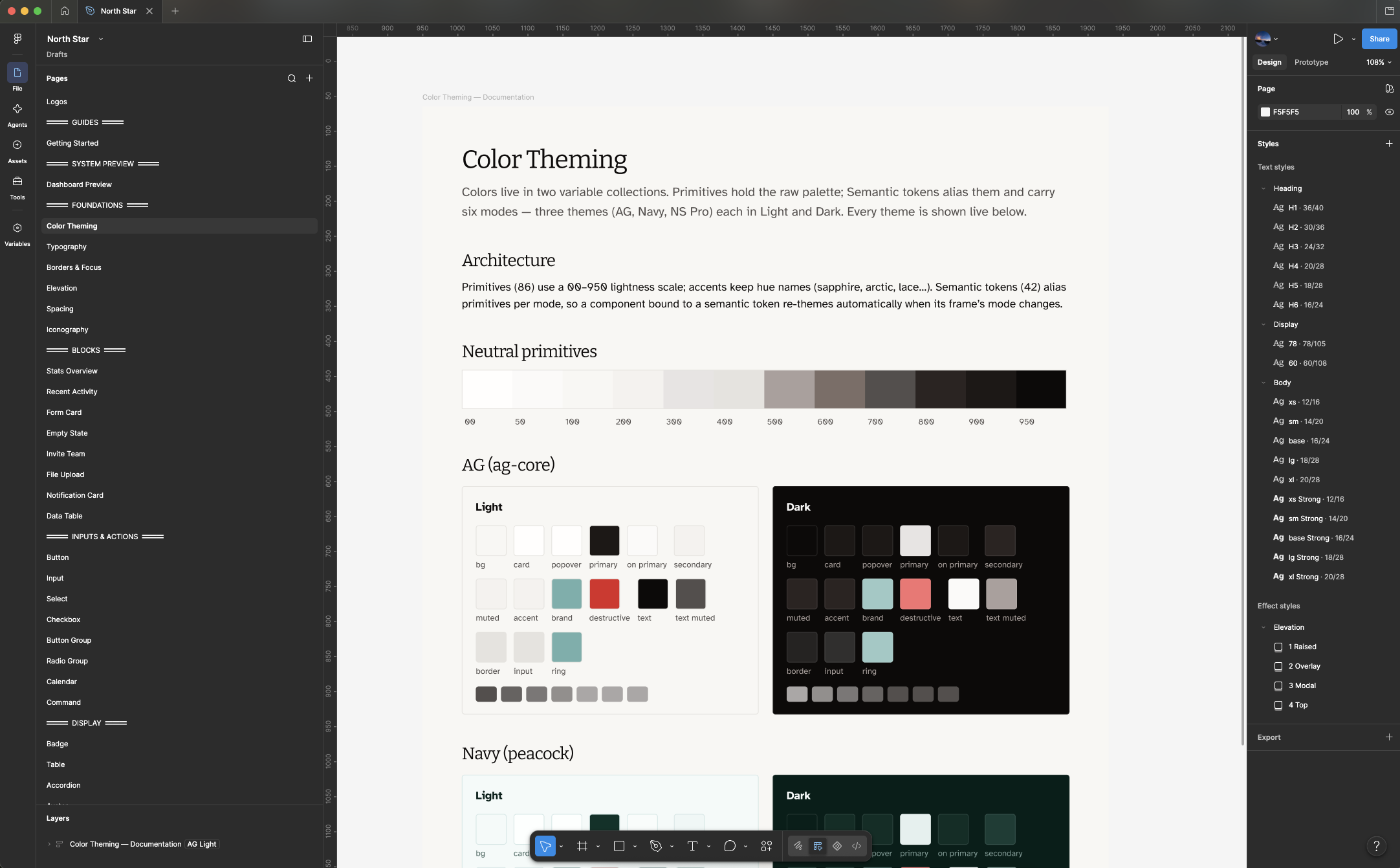
TOKEN LIBRARY IN FIGMA
Semantic tokens (and their primitive aliases) live in Figma Variables across multiple product themes, AG, Navy, NS Pro, light and dark, so theming is a mode switch, not a redesign.
SAME COMPONENT, TWO TOOLS
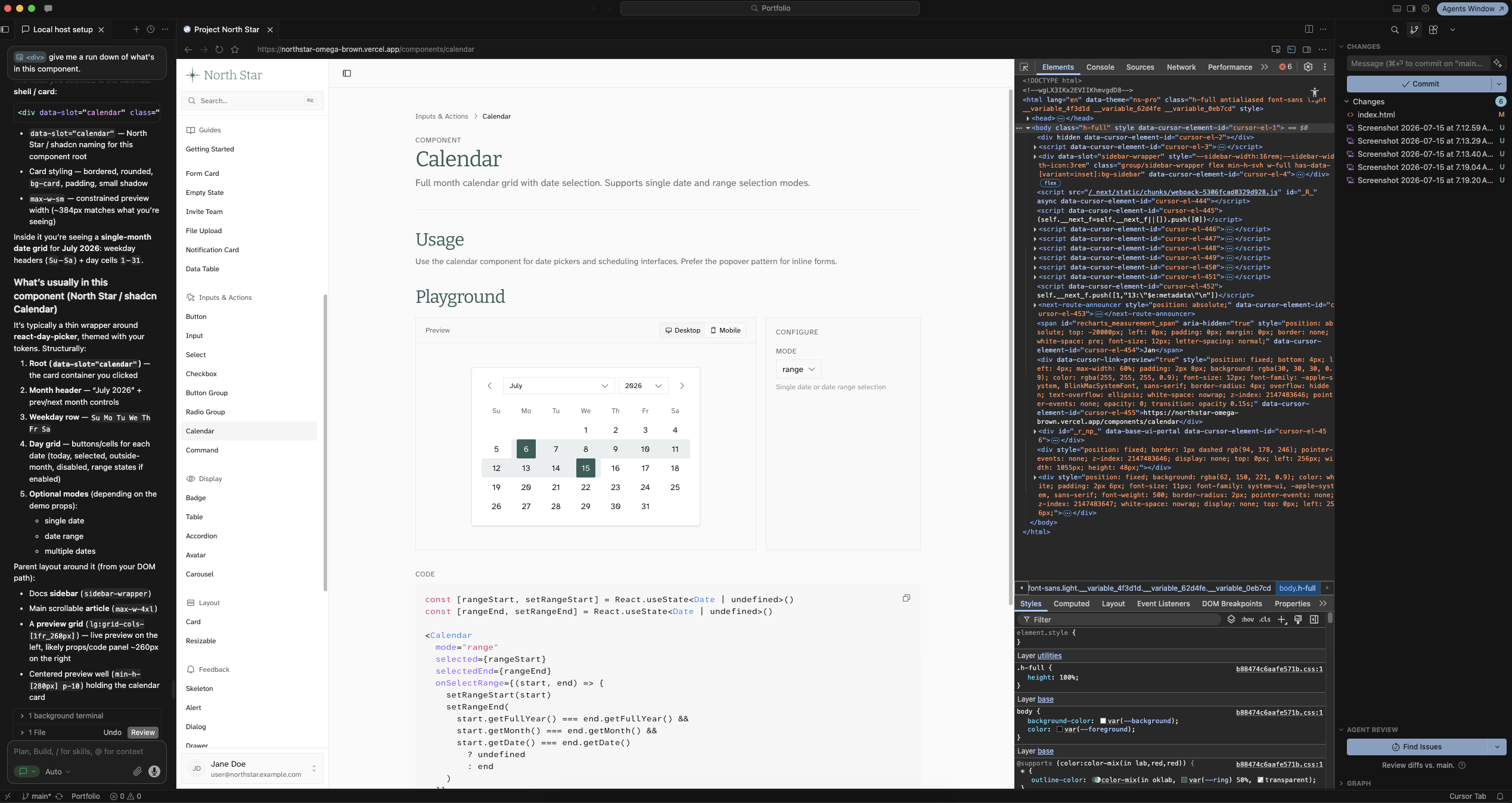
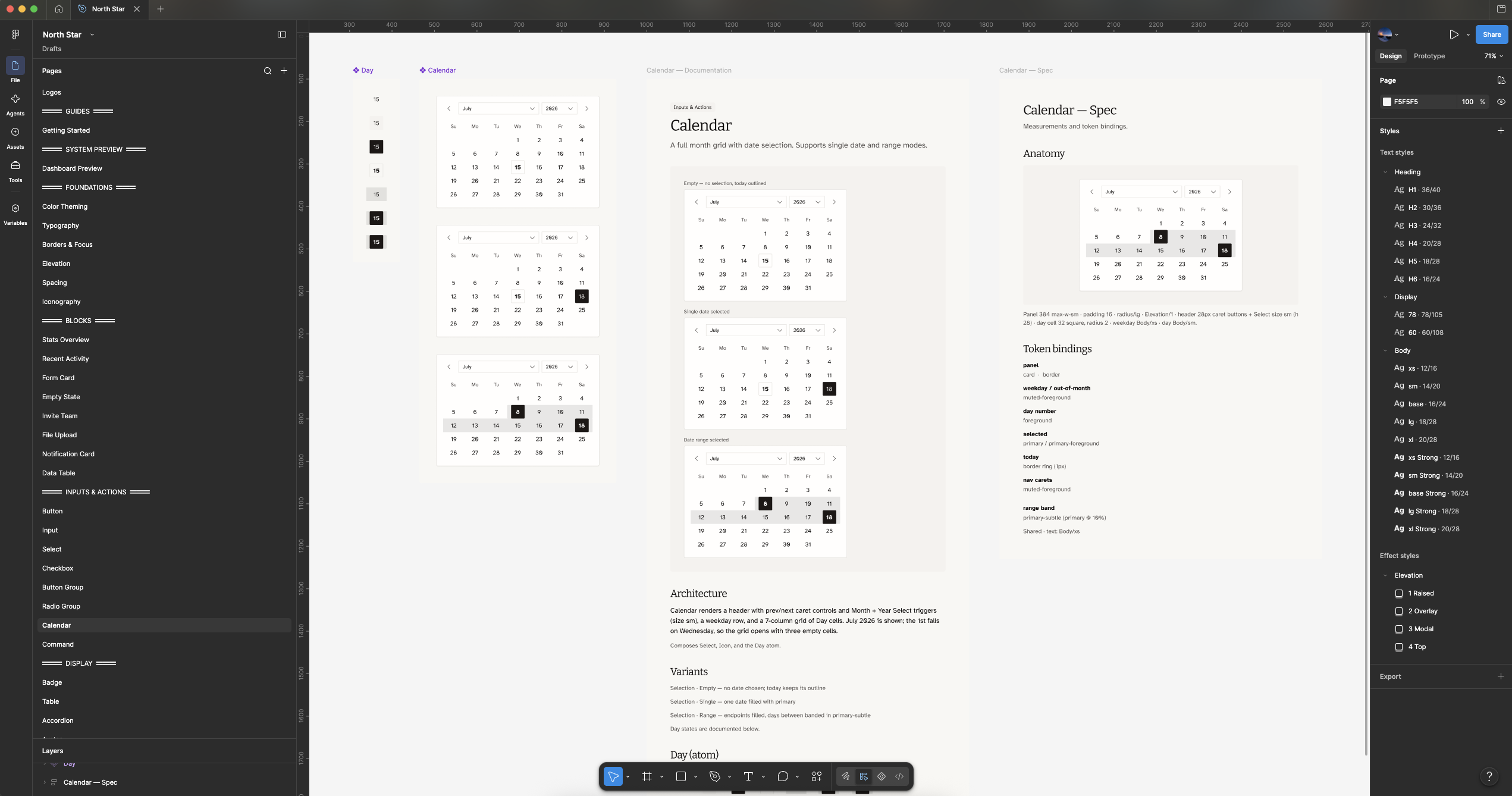
Calendar in Cursor & Figma
A single Calendar component, documented with a live playground and code in the registry, then mirrored in Figma so designers and engineers aren't maintaining two different calendars. The parity is the point: change once, update everywhere.
IN CURSOR, DOCS + PLAYGROUND + SOURCE
IN FIGMA, SAME COMPONENT, DESIGN-READY
VIBE-CODING AS THE PRIMARY USE CASE
When a designer or PM opens an AI prototyping tool and asks for a settings page with a plan-upgrade card, the tool assembles UI from whatever vocabulary it has. Point it at a generic component set and you get generic output. Point it at North Star's registry, installed into the project, with semantic tokens and typed, documented components, and the assembled prototype inherits the brand automatically. The workflow shifted from "generate something, then spend an afternoon making it on-brand" to "generate something that's already on-brand, then refine the ideas."
That speed and accuracy pays off twice. It buys back the time that used to go into making a prototype look believable, time that goes into user testing instead, so ideas get validated with real people earlier and more often. And because the prototype is built from the same registry engineering already uses, handoff isn't a translation exercise: the components in the tested prototype are the same components in the shipped product, so engineering builds faster with fewer surprises.
What It Enables
→Install, don't reinvent, teams pull components in via CLI and own the source, no rebuilding primitives.
→On-brand by default, semantic tokens mean prototypes and products inherit theming, dark mode, and accessibility for free.
→Vibe-code with guardrails, AI tools generate from a designed vocabulary, so output starts on-brand instead of needing cleanup.
→Zero-drift docs, the system's own UI is built from the system, so documentation can't fall out of sync.
→Extensible, not locked, owning the source lets teams adapt for edge cases without forking a dependency.
→More time for testing, less for polish, faster, more accurate prototypes free up time to user-test ideas instead of dressing them up.
→Handoff that's already built, engineers work in the same registry the prototype came from, so shipping is assembly, not translation.
WHAT I LEARNED
/01
Distribution is design. Choosing a registry over a Storybook was the design decision that made adoption effortless, it hands teams the thing instead of describing it.
/02
Dogfooding is the only honest proof. Building the docs from the registry surfaced every rough edge a component-in-isolation view would have hidden.
/03
Semantic tokens are what make AI output look designed. Get the vocabulary right, and both humans and machines produce work that looks like it had a designer behind it.
The Results
33
components in the registry, each installable via CLI
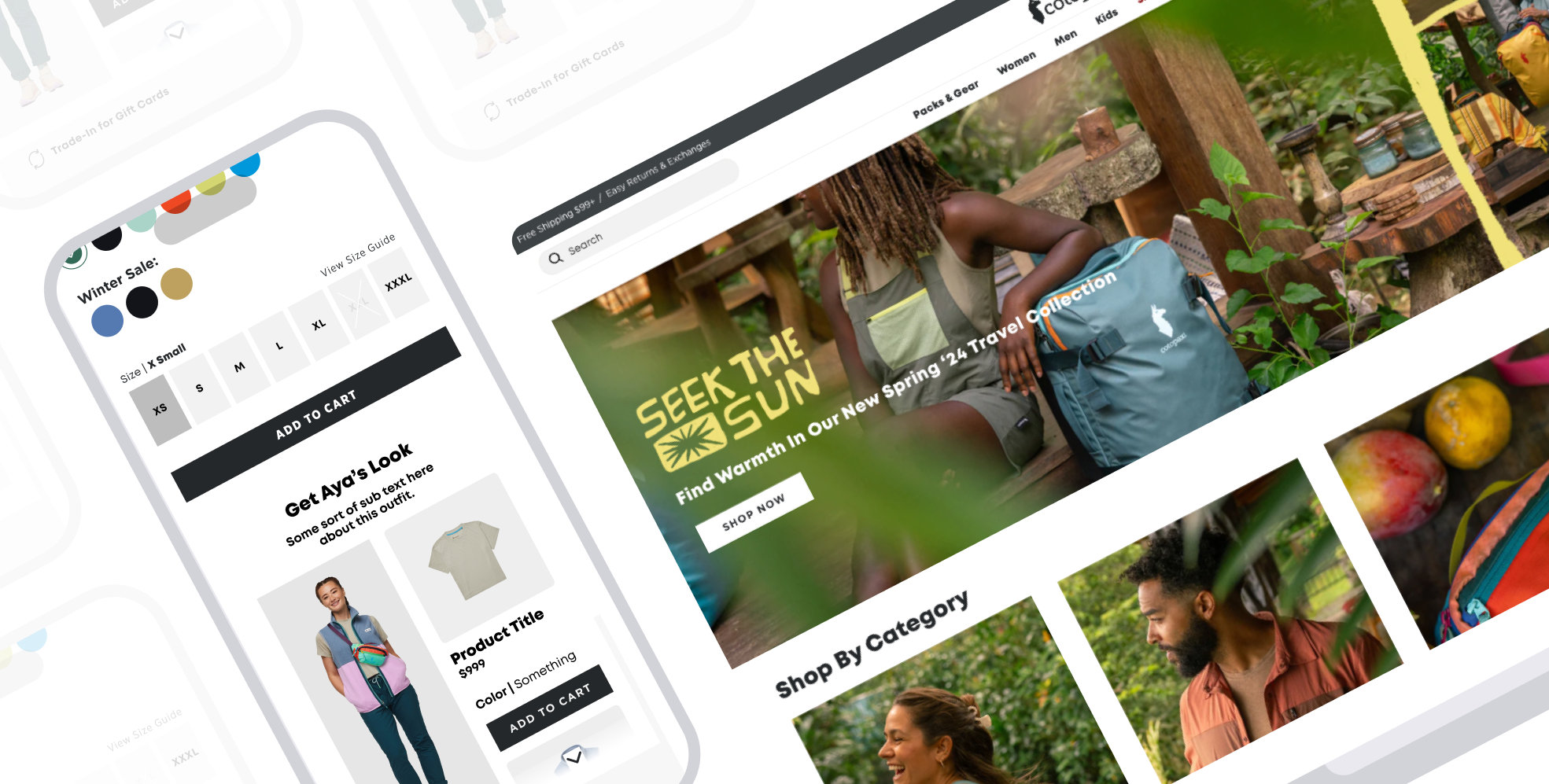
Award-winning conversion experimentation, Sr. UX/UI Designer · Sep 2022–Aug 2024. Featured work: a landing page-style PDP for Cotopaxi's key travel packs, and a 'Complete The Look' cross-merchandising module — two of the shipped experiments behind a Dynamic Yield Personalization Innovator Award and roughly $3M in annualized revenue impact.
★ AWARD
Dynamic Yield Personalization Innovator, 2024, an award for only the savviest Dynamic Yield customers, recognizing brands that understand the true value of customer experiences and find new ways to build use cases and level up personalization.
Senior UX/UI Designer partnered with the CRO team, owning design and experimentation across Cotopaxi's site, from hypothesis to shipped, tested change.
PROBLEM
Cotopaxi faced a persistent headwind of soft AOV and AUR. The CRO team's mandate was to lift conversion and order value without discounting the brand — which meant designing reasons to buy more, not cheaper. Two of the biggest opportunities: travel pack shoppers who needed a fuller 'system' (pack + accessories) presented in one considered experience, and PDP visitors who couldn't easily picture how a single item fit into a full outfit or kit.
OUTCOME
Shipped experiments spanning conversion lifts of +6% to +16% and roughly $3M in combined annualized revenue impact, recognized with the Dynamic Yield Personalization Innovator Award, 2024. The two highest-converting pieces — a landing page-style PDP built for the Allpa travel pack line, and a 'Complete The Look' PDP module — became templates for how Cotopaxi approached bundling and cross-merchandising sitewide.
TECH STACK
{{ x }}
The Process
PHASE /{{ st.num }}
{{ st.t }}
{{ st.d }}
FINDING THE FRICTION
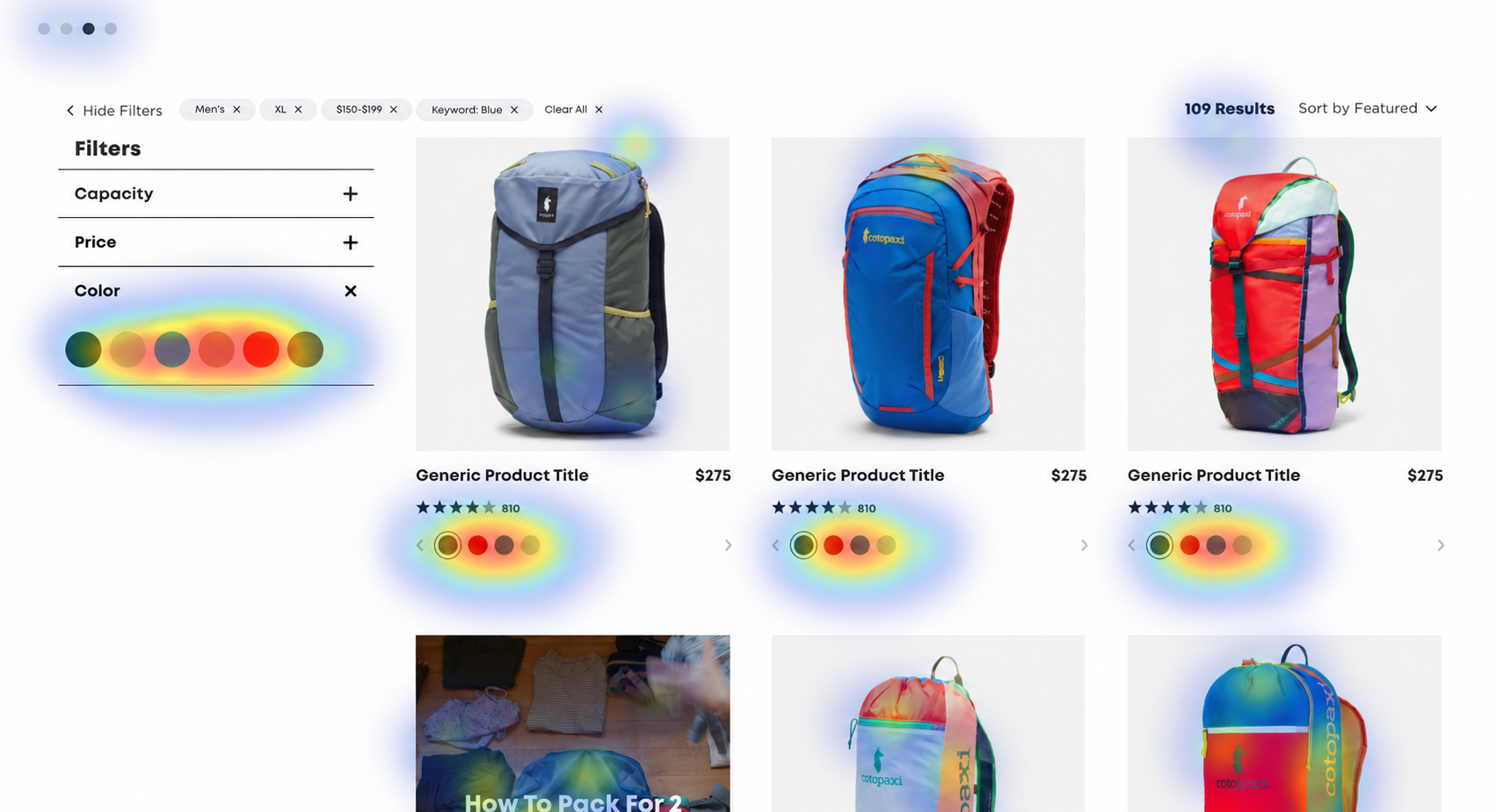
I identified friction through heat mapping and user funneling, formed hypotheses tied to a primary KPI, designed the experiences, and worked with the experimentation stack, Dynamic Yield, to run controlled A/B tests, including holdout groups to measure true incrementality. Every iteration was data-driven and customer-focused.
The Experiments
{{ cpExp.tag }}
{{ cpExp.name }}
{{ cpExp.d }}
{{ cpExp.conv }}
CONVERSION
{{ cpExp.rpv }}
REV/VISITOR
{{ cpExp.rev }}
OF COMBINED IMPACT
{{ img.label }}
{{ img.label }}, SUPPLY IMAGE
{{ cpExp.name }}, SUPPLY IMAGE
WHAT I LEARNED
/01
The fastest way through a design disagreement is a test. Holdout groups turned "I think this is better" into a measured lift, and made design a revenue lever the whole org could trust.
/02
Small, well-instrumented changes compound. Bundling, outfit curation, and navigation work each moved a different KPI; together they added up to millions annualized.
/03
Design for AOV without discounting. Curated outfits and bundles lifted order value by making it easier and more compelling to buy more, not cheaper.
/04
A page can do more than one job. Blending landing-page storytelling with PDP mechanics (Allpa) and merchandising with editorial styling (Complete The Look) outperformed treating those as separate, single-purpose page types.
The Results
+6 to +16%
conversion-rate lifts across shipped experiments
+7 to +17%
revenue-per-visitor lifts across shipped experiments
3/3
experiments proven incremental against a holdout group
DESIGN SYSTEMS & EXPERIMENTATION TOOLING/04
Clean Cosmetics.
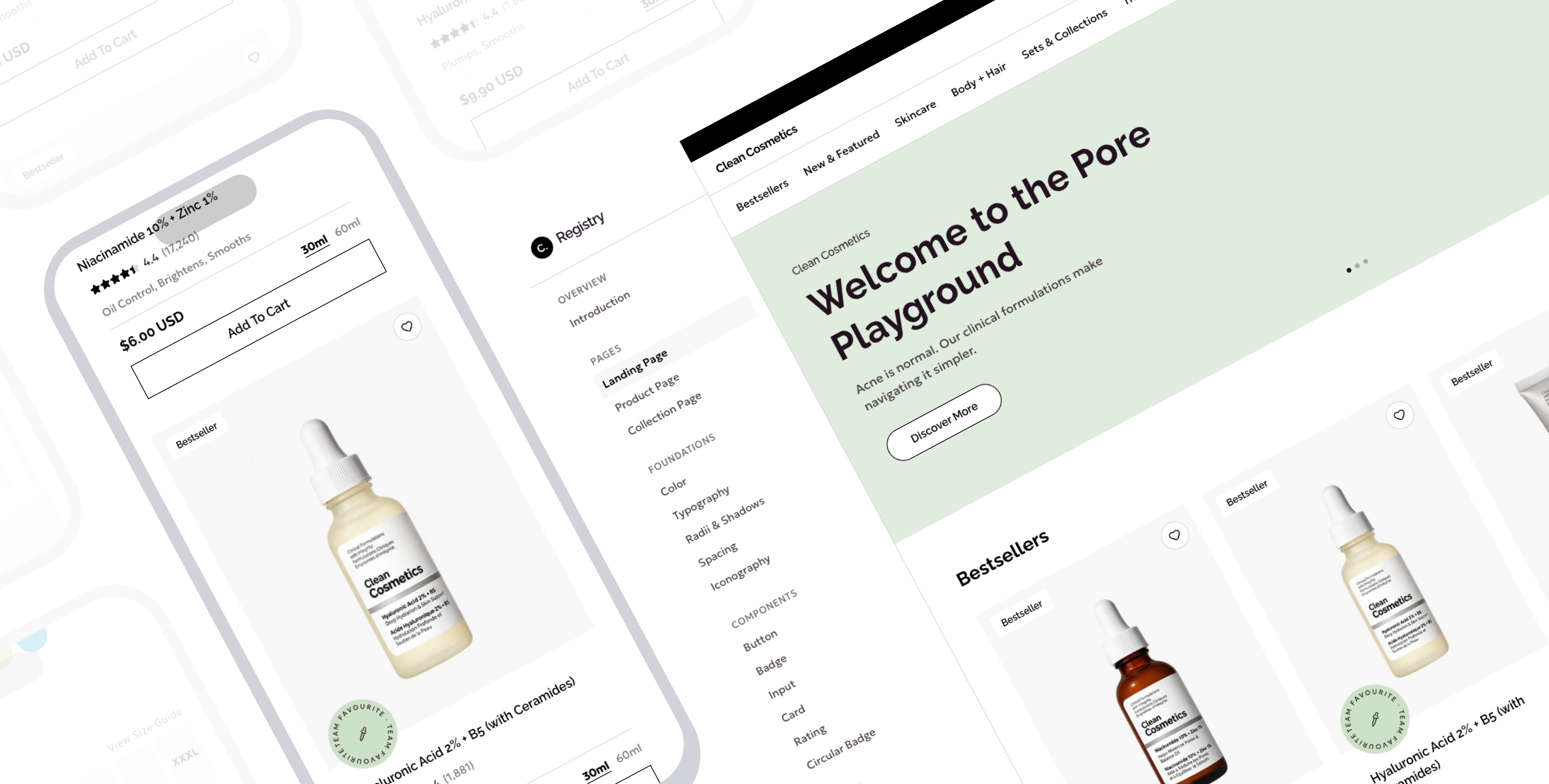
A component registry reverse-engineered from a live storefront, so commerce, CRO, and UX teams can rebuild the real site in a safe sandbox, prototype and A/B test on it, then export the winners to their experimentation platform.
A self-directed system-design study, reverse-engineered from a real cosmetics storefront (anonymized here as Clean Cosmetics). Stack: Next.js 16, React 19, Tailwind CSS v4, class-variance-authority, TypeScript, a documented component registry with live configurators, built to hand off into an experimentation platform such as Dynamic Yield.
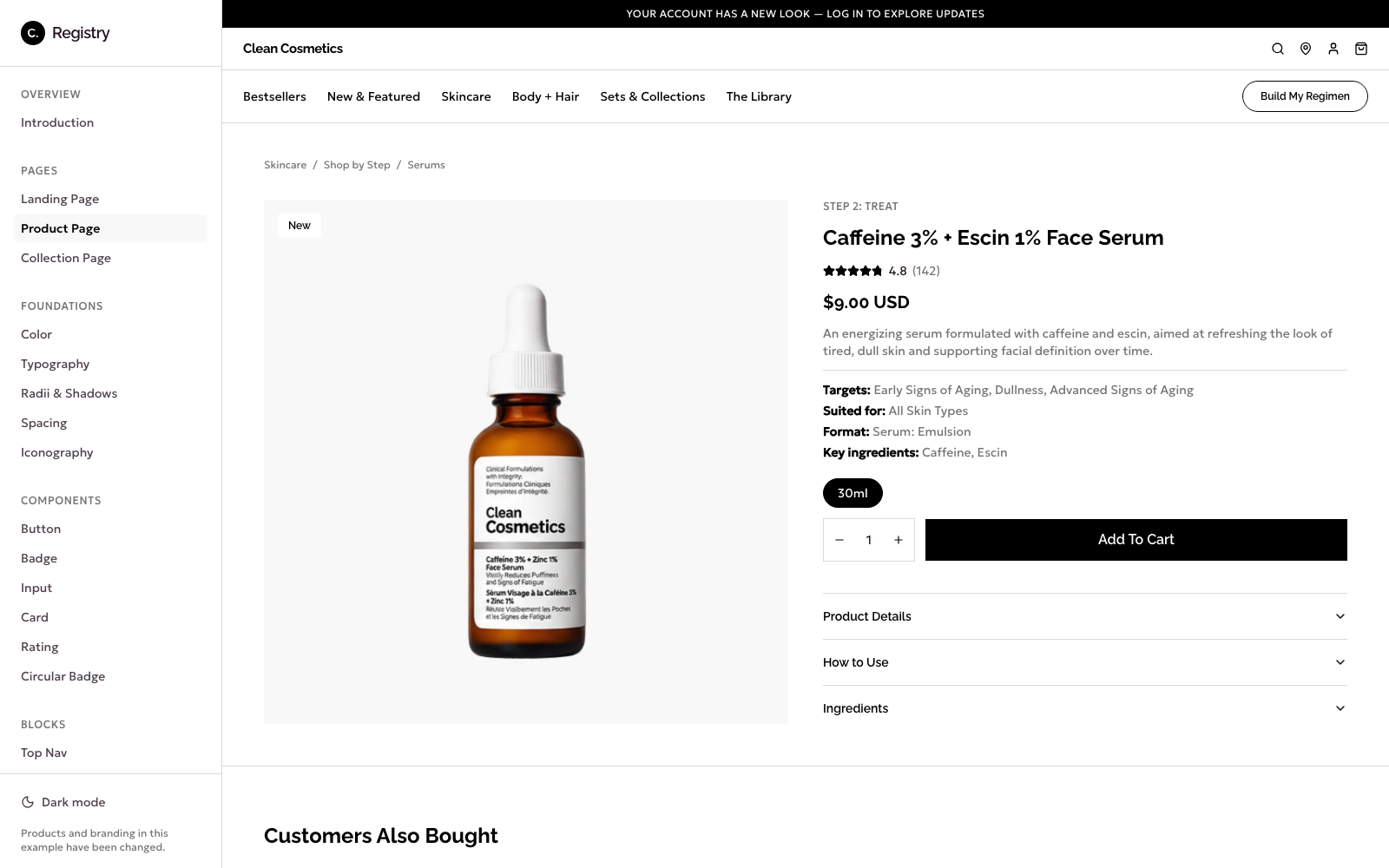
STOREFRONT REPLICA, COMPOSED ENTIRELY FROM REGISTRY COMPONENTS
ROLE & SCOPE
Sole designer-engineer. I reverse-engineered the storefront's visual language into a semantic token layer, authored the component registry and the composed page patterns, built the documentation and live-configurator layer, and defined the experimentation workflow the whole system is built to serve.
PROBLEM
Everyone on an e-commerce team wants to test ideas on the real site, and the real site is the last place you want to experiment on. Today a variant gets built one of two ways: mocked up in a tool that doesn't behave like production, so a "win" in the mock doesn't predict a win live, or coded straight against the production codebase, which is slow, risky, and gated behind an engineering queue. The safe middle ground, a faithful, on-brand replica the team can actually build on and break, usually doesn't exist.
OUTCOME
A component registry read directly from the live storefront's computed styles, so any member of the commerce team can scaffold a pixel-faithful replica in a safe environment, ideate and code improvements against it, assemble A/B-test variants from the real components, and move those variants into their experimentation platform. Production never sees an experiment until it's a validated winner.
TECH STACK
{{ x }}
The Build
PHASE /{{ st.num }}
{{ st.t }}
{{ st.d }}
WHY A SANDBOX, NOT A MOCKUP
A mockup shows an idea; it doesn't behave like the site. A layout that tests well in Figma tells you nothing reliable about how it performs against real traffic, because the thing being judged isn't the thing that ships. Clean Cosmetics is a working replica: real components, real tokens, real interactions, in a repo the team owns. You don't describe the change, you build it, on a site that acts like the real one, safely away from production.
REVERSE-ENGINEERED, NOT REDRAWN
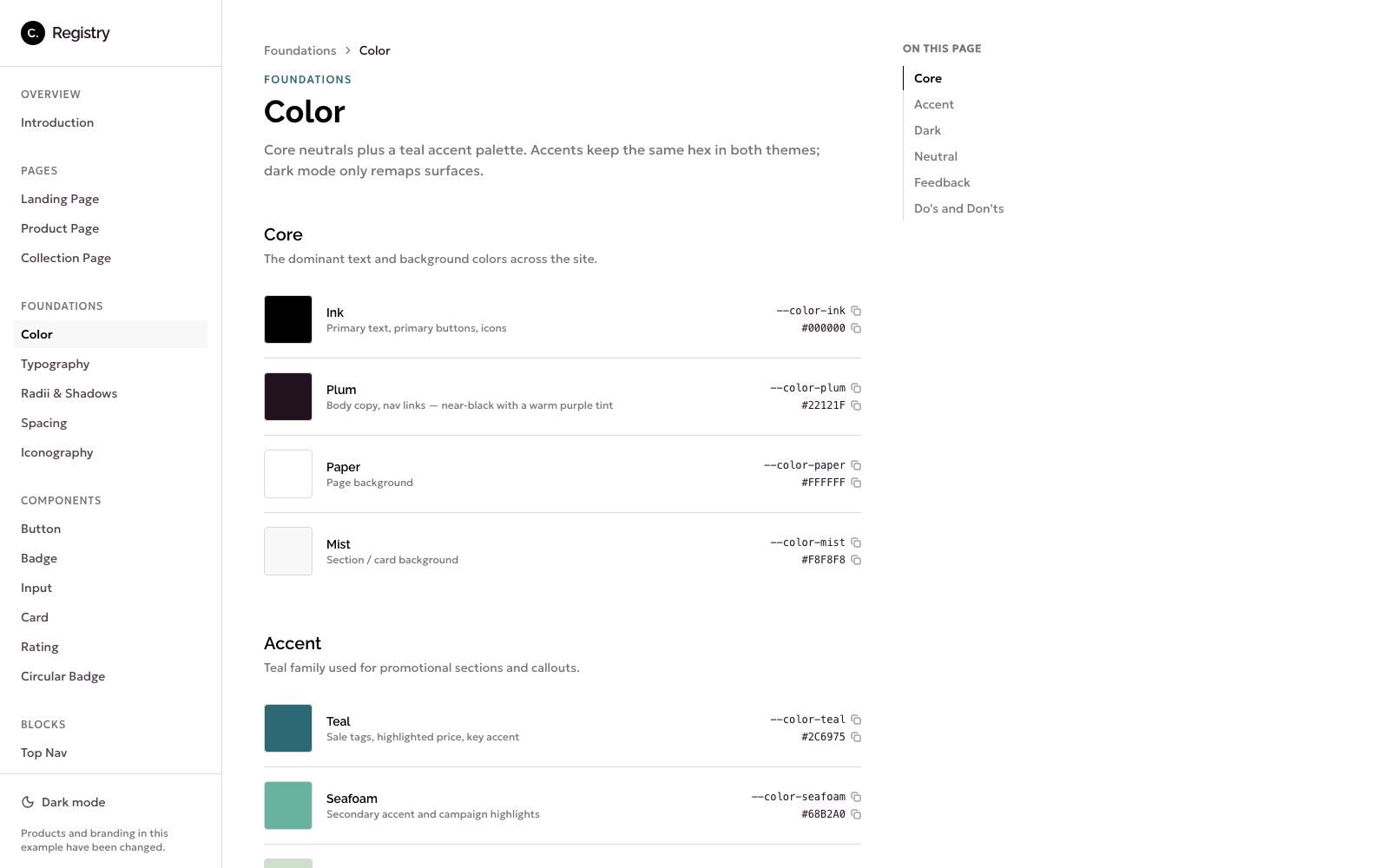
Every token was read from the live storefront's computed styles, the actual hex values, font stacks, radii, and shadows the brand already ships, then rebuilt as a documented, reusable kit. The point isn't a pixel-perfect clone. It's proving that a real brand's visual language can be captured as tokens and reassembled into a working system, one that experiments transfer out of cleanly, because the replica and the production site speak the same design language.
BUILT FOR THE WHOLE COMMERCE TEAM
The registry isn't aimed at engineers alone. It's built so everyone who touches the storefront can work from the same source of truth.
COMMERCE & PRODUCT
Commerce managers and product owners scope and pressure-test merchandising and layout ideas on a real replica before committing engineering time.
CRO & EXPERIMENTATION
CRO specialists assemble variants from the real components and structure them as A/B tests, so what gets tested is what would actually ship.
UX & DESIGN
Designers ideate in code against production-faithful patterns instead of static mockups, and hand off variants that are already built.
FROM IDEA TO LIVE TEST
The workflow the system is designed around: scaffold the replica, ideate on an improvement, code it against the real components, assemble the A/B variant, and export it into the experimentation platform such as Dynamic Yield. Because the variant is built from the same tokens and components as the replica, moving it into the test platform is assembly, not re-creation. And because it never touched production to get built, the only thing that ever reaches live traffic is a validated test.
What It Enables
→Test on a replica, not the real thing, build and break a faithful copy without risking production or waiting on an engineering slot.
→On-brand by extraction, tokens read straight from the live site, so every variant is automatically true to the real brand.
→From idea to variant, in code, ideate and build the improvement in the same components the store runs on, so results transfer.
→A/B-test-ready, variants are structured to drop into an experimentation platform like Dynamic Yield with minimal rework.
→Safe by default, experimentation happens in a sandbox; production only ever sees the winner.
→One source of truth for the whole team, commerce, product, CRO, and UX all work in the same replica, from the same components.
WHAT I LEARNED
/01
Fidelity is what makes a test trustworthy. A sandbox only earns its keep if it behaves like production. Extracting real tokens, not eyeballing them, is what made results transferable.
/02
The safe environment is the unlock. Giving non-engineers a place to actually build, not just mock, is what turns "we should test that" into a shipped experiment.
/03
Build for the export, not just the demo. Designing components to leave the system cleanly, into an A/B platform, mattered more than making them look good in isolation.
LIVE PROJECT
Explore the System
Browse the full Clean Cosmetics registry, component library, configurators, and page replicas in the live design system.
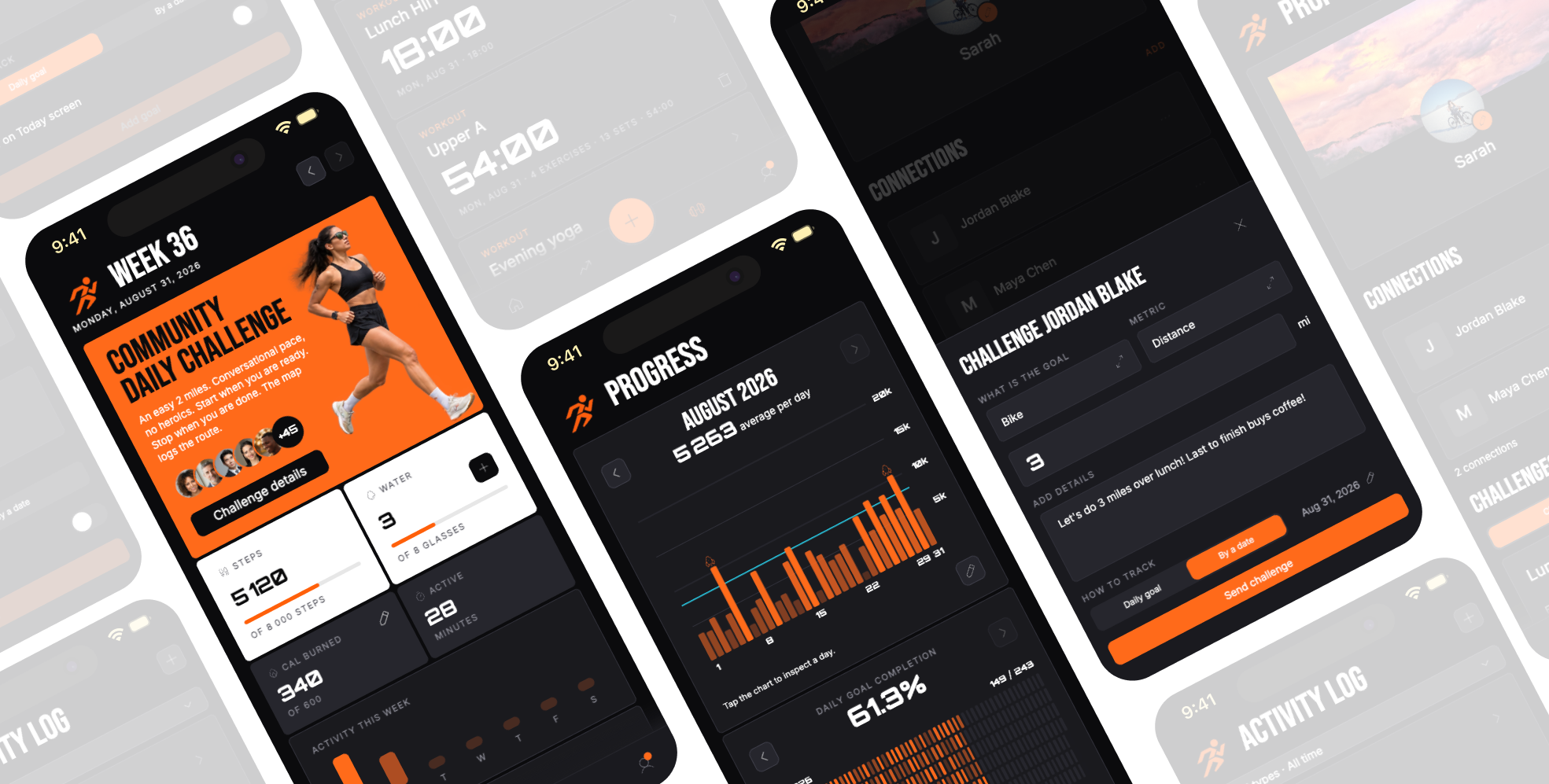
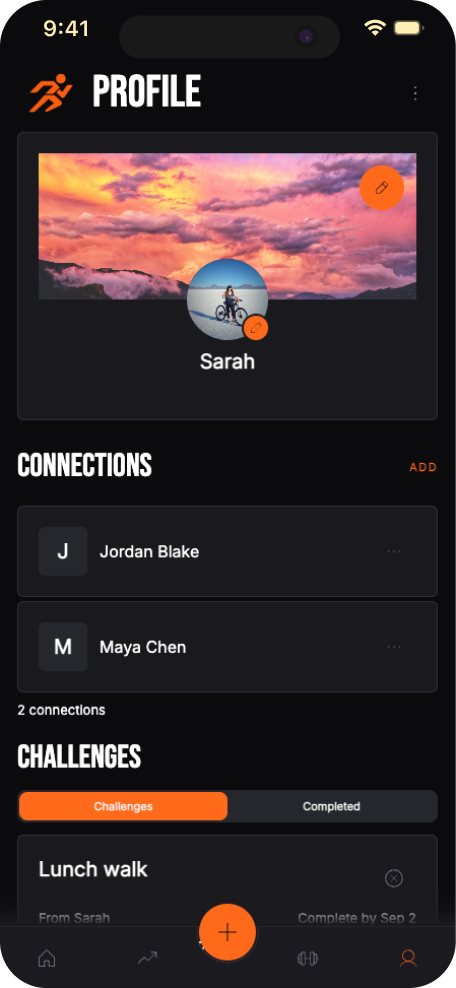
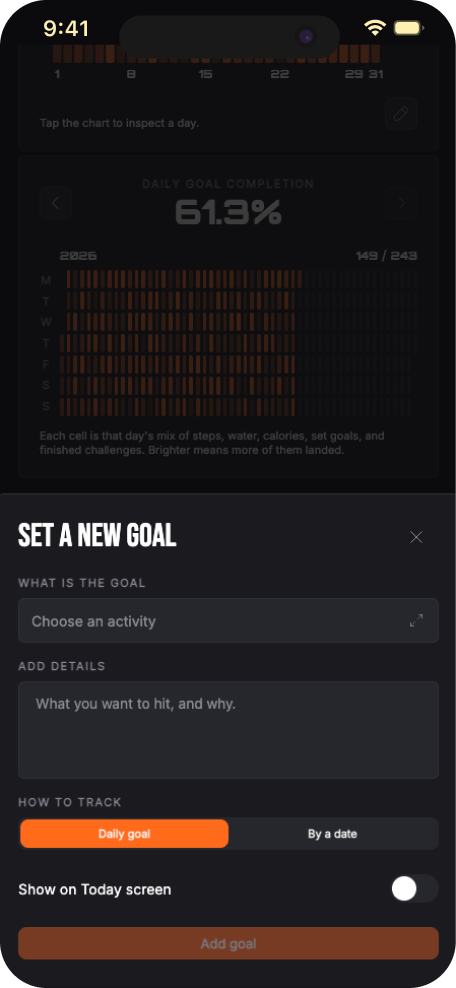
A dark, mobile-only fitness app for iOS and Android that brings your daily stats, completed workouts, and friend challenges into one place instead of three separate apps.
A personal design study. Phones only, no tablet layout, no light mode. I designed the full experience and built a working prototype with AI-assisted coding, using sample data so I could focus on the UI before connecting a live backend.
FOUR SURFACES, ONE PRODUCT
ROLE & SCOPE
Sole designer on the project. I owned the visual language, screen flows, component library, and overall product structure, and built out the working prototype with AI-assisted coding tools.
PROBLEM
Fitness usually lives in three disconnected places: a numbers app for steps and calories, a logging app for workouts, and a social app for challenges with friends. Nothing stays in sync. You finish a workout in one app, your streak lives in another, and the friend who challenged you never sees it.
OUTCOME
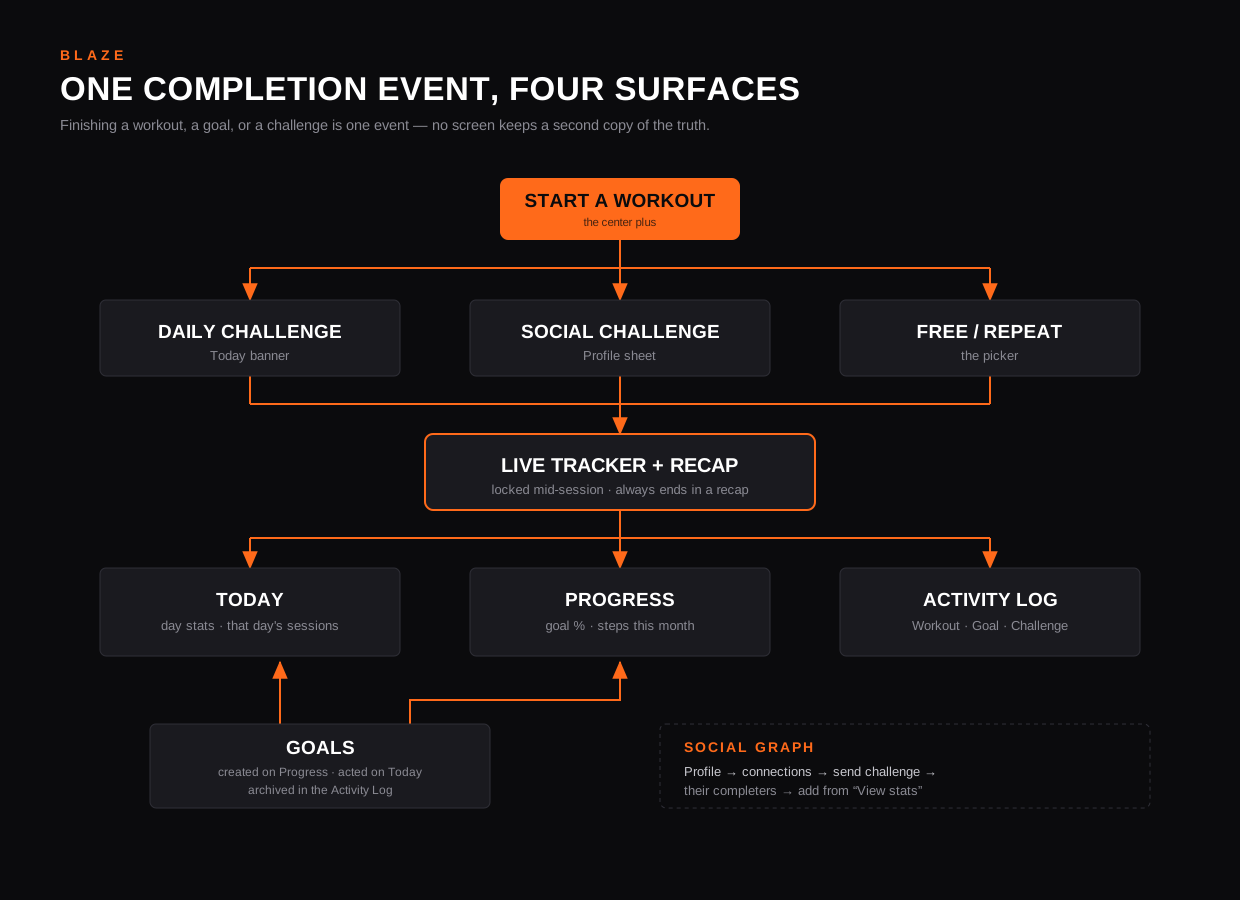
One app where finishing a workout, goal, or challenge updates your daily stats, progress scoreboard, activity history, and any friend challenge at the same time. A consistent dark visual system ties the four main screens together so the app feels like one product, not four stitched together.
TECH STACK
{{ x }}
The Build
PHASE /{{ st.num }}
{{ st.t }}
{{ st.d }}
ONE FINISH UPDATES EVERYTHING
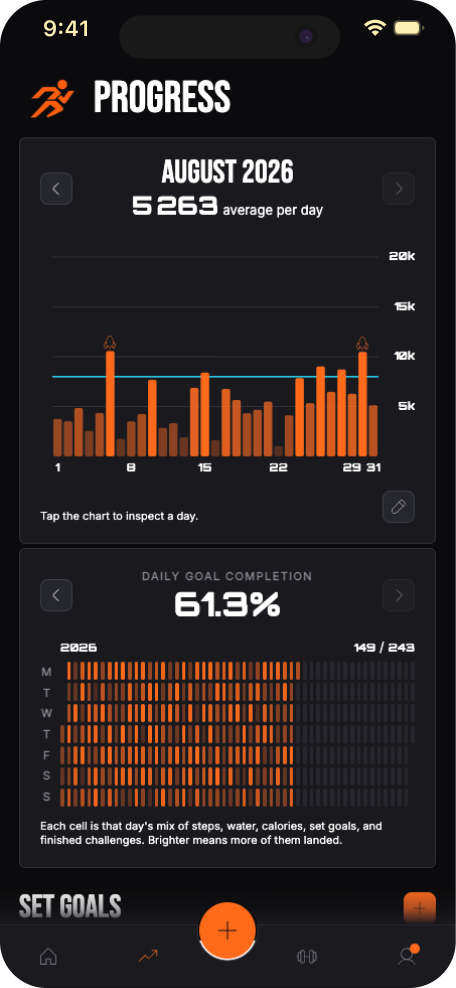
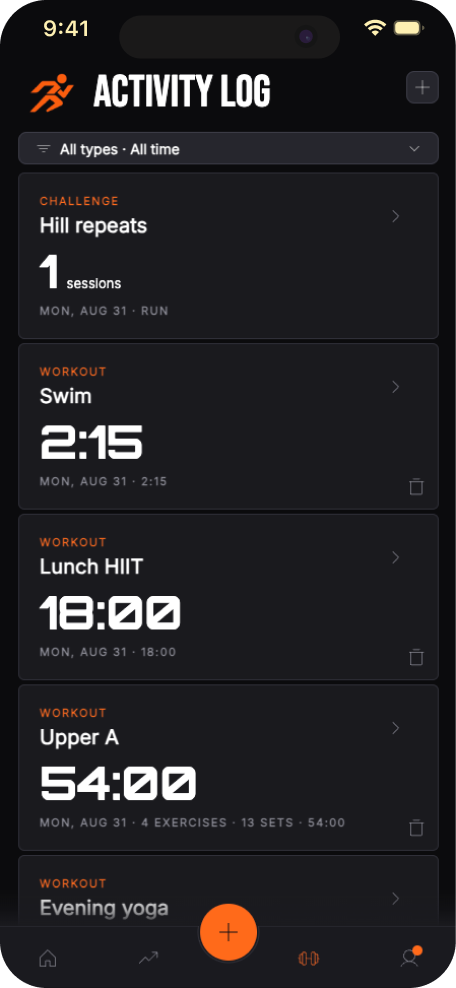
The whole product is built around one idea: you finished something. When you complete a workout, goal, or challenge, the rest of the app already knows. Today shows your stats for the day. Progress turns completions into simple scores, not another social feed. Activity Log keeps everything on one timeline. And if a friend challenged you, finishing the workout closes that loop too. Log it once, and every screen stays in sync.
WHITE MEANS “TODAY, PERSONAL”
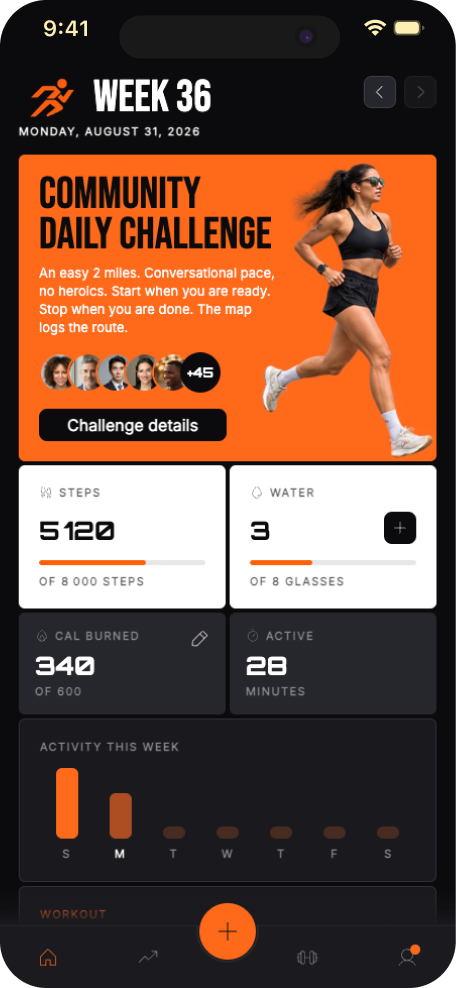
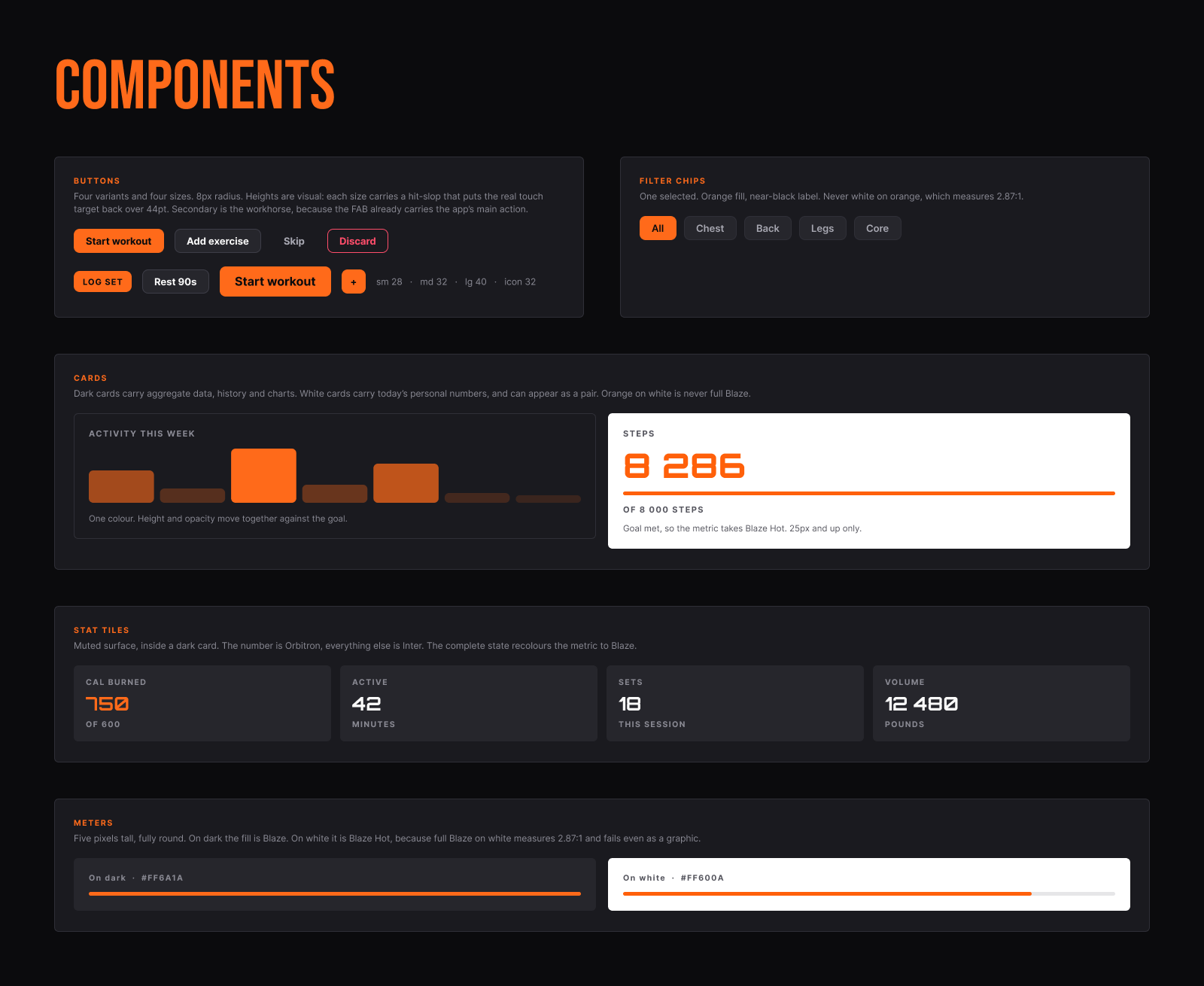
A simple rule runs through the whole app: white cards mean today and personal, like steps and water on the Today screen. Charts, lists, and past workouts stay on dark cards. It is an easy way to tell what is happening right now versus what already happened.
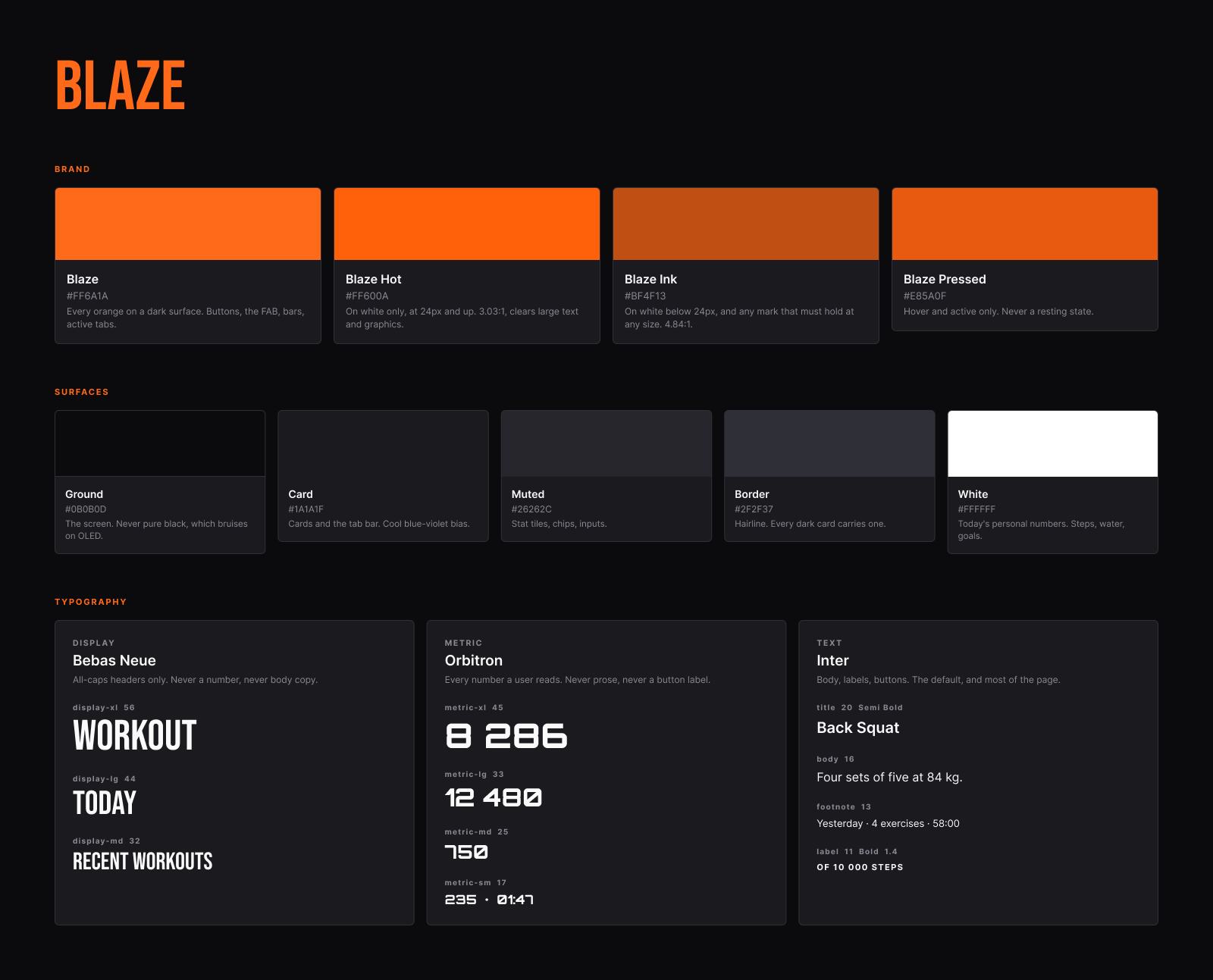
THE BLAZE SYSTEM
One bold orange on a near-black background, with strict rules so text stays readable. Headers use Bebas Neue, big numbers use Orbitron, and body copy uses Inter. I also designed a timer so the clock digits do not jump around while you are working out.
BUTTONS, CARDS & METERS
A small set of reusable pieces carries the whole UI: buttons, cards, stat tiles, and progress meters. Buttons come in a few sizes and styles with touch targets big enough to tap comfortably. Stat tiles shift to orange when you hit a goal. Progress bars follow the same color rules as everything else.
ONE WORKOUT FLOW
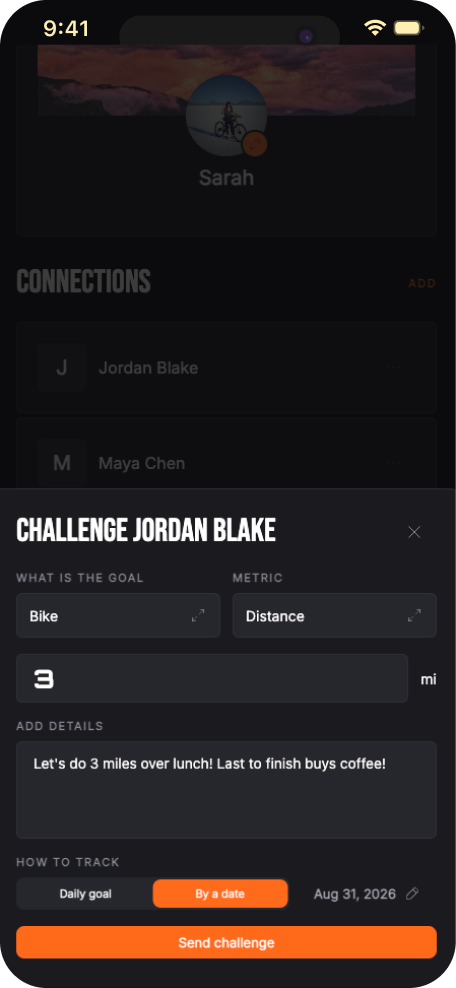
Every way to start a workout, the plus button, repeating a past session, or accepting a challenge, leads into the same live workout screen and the same finish summary. A friend challenge uses the same flow as setting a personal goal, just sent to someone instead of pinned to Today. One flow to design and maintain, four ways to get there.
FOUR SURFACES, ONE EVENT
PROGRESS — RATES, NOT A FEED
ACTIVITY LOG — ONE TIMELINE, THREE KINDS
PROFILE — A SOCIAL PAGE, NOT A SETTINGS DUMP
GOALS — MADE ON PROGRESS, ACTED ON TODAY
What It Enables
→One finish, four screens, completing a workout, goal, or challenge updates your day, progress, history, and friend challenges at once.
→Color as hierarchy, white means today and personal, dark means history and totals, so you can tell at a glance what you are looking at.
→Designed with sample data, I could build and demo the full app with realistic placeholders before connecting a live backend.
→One workout flow, every way to start a workout ends in the same screen and summary, so there is one experience to polish, not four.
WHAT I LEARNED
/01
A design system is a set of rules, not just colors. The constraints, like no white text on orange and white cards only for today, are what made the app feel consistent.
/02
Design around what people finish, not around separate features. That one idea is what turned three apps into one.
/03
Sample data kept design moving. I could polish every screen and test the full flow without waiting on backend setup.
PLATFORM & SCOPE
Blaze is a native iOS and Android app, so there is no public web link to share. Payment, device pairing, and health app integrations are planned next steps, not part of this study.
EXPERIENCE & EDUCATION
Resume.
Senior Product Designer and Lead Designer with 8+ years in product design and 25+ years of creative experience across 10+ industries. I specialize in scalable design systems, AI-assisted design and front-end implementation, and conversion-driven UX, taking work from strategy and research through to shipped, production-ready code. I build component libraries and registries teams design from, prototype rapidly with AI tools including Claude Code, Cursor, Figma MCP, and v0, design AI-powered product features, and lead design at scale across product, engineering, and go-to-market teams. Based in Northern Colorado.
SKIP THE RED TAPE
Your questions, answered.
SKIP THE RED TAPE
Experience
/{{ j.num }}
{{ j.co }}
{{ j.role }}
{{ j.meta }}
★ AWARD
{{ j.award }}
→{{ b }}
SKILLS & TECH
{{ j.skills }}
Education
/{{ e.num }}
{{ e.school }}
{{ e.deg }}
The Toolkit
{{ tk.cat }}
{{ x }}
Recommendations
{{ recNum }} / {{ recTotal }}
"{{ rec.q }}"
SKIP THE RED TAPE
Interview.
{{ f.cat }}
{{ para }}
{{ f.quote }}
STILL HAVE QUESTIONS?
BEYOND THE PIXELS
Other Art.
Photography and personal work, a BA in Commercial Photography put the camera in my hands first.
{{ a.label }}{{ a.f }}
STRIPED TILES = PLACEHOLDERS, SARAH'S REAL PHOTOGRAPHY & ART DROPS IN HERE
GET IN TOUCH
Let's Connect.
Have a role, a project, or just a question? I'd love to hear about it.